,"You really have to be driven by that idea, it can't be something that is started only for money, but for some slightly bigger initiative. I look at it more like I want to leave a mark, to do something big, to be successful. I am aware that with success comes money, but that is not my focus. My focus is exactly success and that I contribute something to this community, that I have something that works, that is mine, that I developed. I, well, I kind of like that idea and I often use this idea - Something must be driving you. – especially since I grew up with her.”
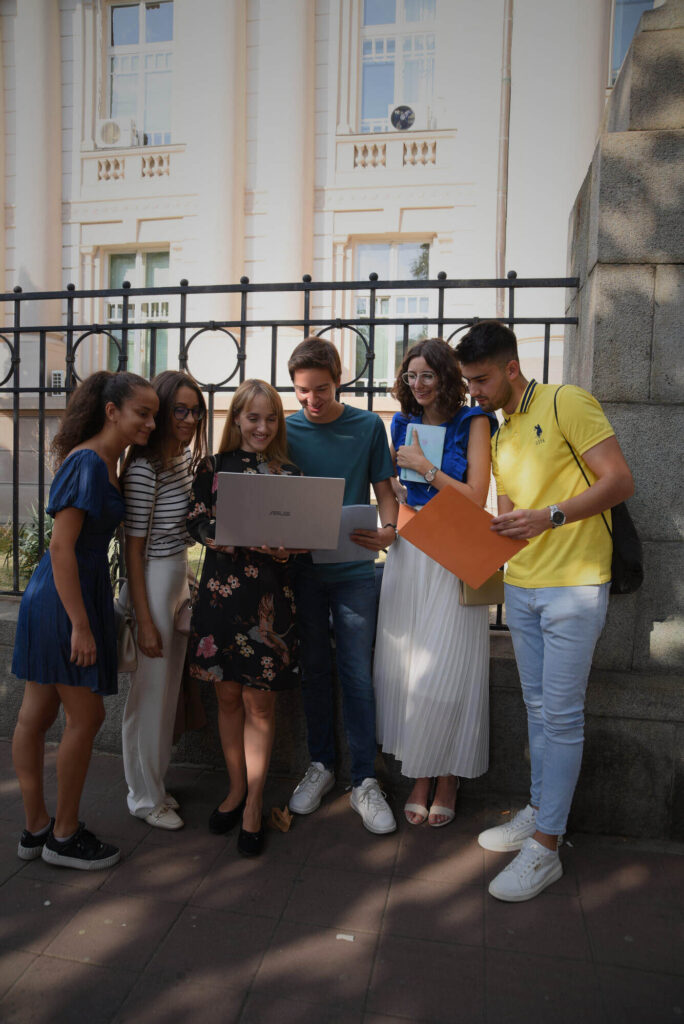
Today I am talking to my peer, my college colleague, Angela Canyo, a girl who started her own business in her third year of high school. Today, Anđela is a second-year student at the Faculty of Organizational Sciences majoring in Software Engineering and, together with her colleague Filip Oketić, is the founder of the Moveably platform. Moveably is a digital platform that connects carriers and their potential clients. The platform works according to the principle of bidding, which means that the client, i.e. a company or an individual who needs transport, places information on the platform, after which the carriers then bid, and then the client chooses the offer that suits him best. Moveably is a unique way to connect these two parties, and she came up with the idea, as she states, by researching what is less represented and accessible in this area. As she says, Angela grew with her idea, starting from school, through the National competition of the best student companies, and all the way to the European competition of the best student companies in Estonia after winning the national competition. To a few of my questions about herself, her platform, the faculty and balancing obligations, motivation and limitations that she, like all young people, encountered in her career path, Angela answered:
Given that you are a student at the Faculty of Organizational Sciences, and that you started Moveably as a high school student, how do you manage to balance between the faculty and running your own business today?
I've been doing a lot of entrepreneurship since the first year of high school, so I always had some extra activity, plus music school, in elementary school it was training, sections where I danced and acted. So I can say that these extracurricular activities are literally an integral part of me and I really like that we are busy. As for how I manage to balance college and work, I think it's important that I don't look at college as something that's so scary and boring, but look at it as a source of contacts, to find out some new competitions for Moveably, etc. It's just a source of free information, that's how I see it. There are people who will always help you, who will always listen and guide you. They're there to teach us, so I guess it's a free course, as they say. Of course it can be difficult during exam periods when everything comes together, but apart from that it's really wonderful to have both.
Did and in what way did the faculty contribute to more successful startup management? What are the most important knowledge that you picked up at the university, and which are the most applicable in concrete practice? Given that you are a member of FONIS (FON Informatics Students Association), I am interested in your opinion on the concept of student organizations in general, what are the benefits that you have gained by being a member of that student organization and the projects it organizes, and would you recommend it to other students?
The Faculty of Organizational Sciences provides a lot to me personally. One of the reasons I entered it is that I knew that they focus a lot on students and precisely on that management and business part. I think that anyone who wants to learn can learn even more at this faculty, if only they want to. I have wonderful experiences with professors who are always open to give new projects, to include students in some of their activities, so I think they are a really good support, especially the professors who are involved in the work of the Research and Development Center of FON. They really contributed in those directions. What the faculty helped me with the most was to enter the world of business and use the concepts and phrases that are necessary in it. He helped me better understand how startups are actually presented, that it's not just an idea and a presentation, but that you should be aware of all the advantages and disadvantages, the problems we solve and why we do it. This faculty teaches you very well not to talk too much, but to say the essence.
Student organizations are a great thing for me because they prepare us for that corporate and business world. What makes them particularly important is that they are definitely the best source of contact, there are many people whom I met on projects and in the organization itself, and with whom I later collaborated on the startup as well. All recommendations for people to try out, even if only in one project, purely to see how a larger project organization works, because a project is a really complex thing. Organizations are not only great for socializing, networking, parties, but also for learning how to manage projects, which is actually running a company. I gained numerous skills in the organization, among other things that I am not afraid to ask when I need help, which I think is very important when you have a startup because we don't know everything, especially when we are this young. We lack knowledge, so the people around us are our greatest resource.
What were the biggest challenges you faced when launching your startup?
While I was starting my startup, since I never had any work experience, the biggest challenges were definitely from the financial side, since I finished high school and then those finances always looked very scary (and still sometimes look scary), as well as legal issues. There were a lot of unknown and unresolved issues, but we went and are going step by step. The most important thing is that we react on time, but again, there were and are still people around me that I can always ask about anything. That's why I like to say that people are really the most important resource, because without them I wouldn't be able to do this on my own.
What, in your opinion, are the most important qualities and what is the most important thing that someone who wants to launch his startup must invest in?
As for starting a startup, I would really say that the idea must "drive you". It cannot be something that is started only for money, but for some bigger initiatives. Everyone who wants to venture into these waters should understand their idea, to really see the real value in it, and the second thing is discipline. A startup definitely needs discipline because it is not something that can be done a little and not a little. The team is also very important, because, no matter how much we do not match in some others things, we should see the same values and be able to function, and yet be different in terms of some skills and work methods. My colleague and I have the same vision for the company, but we look at things in a different way. I go into detail, and he is quite productive, so when I start to go into detail about things that are not needed, he draws my attention to the fact that we should move on, and again, my detailing has a lot of influence on presenting us and our results well eg at competitions and that we again lead to some new ideas.
In what do you find the most motivation and what is it that moves you on a daily basis, what advice would you give to students and young people in general who face a lack of motivation, self-doubt and their ideas, fear of the opinions of others and the like?
In terms of motivation, I find it in the fact that I really feel good while working on this. I really like that moment when I can sit down and see what can be added, what can be different here, communication with clients. I get an amazing feeling doing this and it really has become such a daily part of my life now that I can't imagine myself without Moveably and its logo around me. As for the opinion of the environment, I don't think it should be taken as necessarily a bad thing. Of course, criticism is never pleasant, but it is extremely useful in the business world and in the startup world, so it is much better to hear what is not good than what is. We all know what is good in our ideas, but sometimes, because we are subjective, it is difficult for us to see what might not work, and it means a lot to me when someone wants to give us a suggestion, especially when that someone is well-intentioned. So, we should not be afraid of the environment, the environment can help us a lot to spot our shortcomings and bring our business to the next, better stage. As far as starting a startup is concerned, we gained knowledge on different programs on how it should be presented, applied for competitions that had financial rewards, and then also a Grant that supports startups in an advisory and financial sense, so that, bit by bit, we can get to that initial capital and initial knowledge. The point is the desire to change something and to contribute, to solve a problem. Start from there, and then be consistent. I would really recommend young people to try their hand at entrepreneurship, even while they're in high school, it's never too early to try these types of competitions and programs.
Today I am talking to my peer, my college colleague, Angela Canyo, a girl who started her own business in her third year of high school. Today, Anđela is a second-year student at the Faculty of Organizational Sciences majoring in Software Engineering and, together with her colleague Filip Oketić, is the founder of the Moveably platform. Moveably is a digital platform that connects carriers and their potential clients. The platform works according to the principle of bidding, which means that the client, i.e. a company or an individual who needs transport, places information on the platform, after which the carriers then bid, and then the client chooses the offer that suits him best. Moveably is a unique way to connect these two parties, and she came up with the idea, as she states, by researching what is less represented and accessible in this area. As she says, Angela grew with her idea, starting from school, through the National competition of the best student companies, and all the way to the European competition of the best student companies in Estonia after winning the national competition. To a few of my questions about herself, her platform, the faculty and balancing obligations, motivation and limitations that she, like all young people, encountered in her career path, Angela answered:
Given that you are a student at the Faculty of Organizational Sciences, and that you started Moveably as a high school student, how do you manage to balance between the faculty and running your own business today?
I've been doing a lot of entrepreneurship since the first year of high school, so I always had some extra activity, plus music school, in elementary school it was training, sections where I danced and acted. So I can say that these extracurricular activities are literally an integral part of me and I really like that we are busy. As for how I manage to balance college and work, I think it's important that I don't look at college as something that's so scary and boring, but look at it as a source of contacts, to find out some new competitions for Moveably, etc. It's just a source of free information, that's how I see it. There are people who will always help you, who will always listen and guide you. They're there to teach us, so I guess it's a free course, as they say. Of course it can be difficult during exam periods when everything comes together, but apart from that it's really wonderful to have both.
Did and in what way did the faculty contribute to more successful startup management? What are the most important knowledge that you picked up at the university, and which are the most applicable in concrete practice? Given that you are a member of FONIS (FON Informatics Students Association), I am interested in your opinion on the concept of student organizations in general, what are the benefits that you have gained by being a member of that student organization and the projects it organizes, and would you recommend it to other students?
The Faculty of Organizational Sciences provides a lot to me personally. One of the reasons I entered it is that I knew that they focus a lot on students and precisely on that management and business part. I think that anyone who wants to learn can learn even more at this faculty, if only they want to. I have wonderful experiences with professors who are always open to give new projects, to include students in some of their activities, so I think they are a really good support, especially the professors who are involved in the work of the Research and Development Center of FON. They really contributed in those directions. What the faculty helped me with the most was to enter the world of business and use the concepts and phrases that are necessary in it. He helped me better understand how startups are actually presented, that it's not just an idea and a presentation, but that you should be aware of all the advantages and disadvantages, the problems we solve and why we do it. This faculty teaches you very well not to talk too much, but to say the essence.
Student organizations are a great thing for me because they prepare us for that corporate and business world. What makes them particularly important is that they are definitely the best source of contact, there are many people whom I met on projects and in the organization itself, and with whom I later collaborated on the startup as well. All recommendations for people to try out, even if only in one project, purely to see how a larger project organization works, because a project is a really complex thing. Organizations are not only great for socializing, networking, parties, but also for learning how to manage projects, which is actually running a company. I gained numerous skills in the organization, among other things that I am not afraid to ask when I need help, which I think is very important when you have a startup because we don't know everything, especially when we are this young. We lack knowledge, so the people around us are our greatest resource.
What were the biggest challenges you faced when launching your startup?
While I was starting my startup, since I never had any work experience, the biggest challenges were definitely from the financial side, since I finished high school and then those finances always looked very scary (and still sometimes look scary), as well as legal issues. There were a lot of unknown and unresolved issues, but we went and are going step by step. The most important thing is that we react on time, but again, there were and are still people around me that I can always ask about anything. That's why I like to say that people are really the most important resource, because without them I wouldn't be able to do this on my own.
What, in your opinion, are the most important qualities and what is the most important thing that someone who wants to launch his startup must invest in?
As for starting a startup, I would really say that the idea must "drive you". It cannot be something that is started only for money, but for some bigger initiatives. Everyone who wants to venture into these waters should understand their idea, to really see the real value in it, and the second thing is discipline. A startup definitely needs discipline because it is not something that can be done a little and not a little. The team is also very important, because, no matter how much we do not match in some others things, we should see the same values and be able to function, and yet be different in terms of some skills and work methods. My colleague and I have the same vision for the company, but we look at things in a different way. I go into detail, and he is quite productive, so when I start to go into detail about things that are not needed, he draws my attention to the fact that we should move on, and again, my detailing has a lot of influence on presenting us and our results well eg at competitions and that we again lead to some new ideas.
In what do you find the most motivation and what is it that moves you on a daily basis, what advice would you give to students and young people in general who face a lack of motivation, self-doubt and their ideas, fear of the opinions of others and the like?
In terms of motivation, I find it in the fact that I really feel good while working on this. I really like that moment when I can sit down and see what can be added, what can be different here, communication with clients. I get an amazing feeling doing this and it really has become such a daily part of my life now that I can't imagine myself without Moveably and its logo around me. As for the opinion of the environment, I don't think it should be taken as necessarily a bad thing. Of course, criticism is never pleasant, but it is extremely useful in the business world and in the startup world, so it is much better to hear what is not good than what is. We all know what is good in our ideas, but sometimes, because we are subjective, it is difficult for us to see what might not work, and it means a lot to me when someone wants to give us a suggestion, especially when that someone is well-intentioned. So, we should not be afraid of the environment, the environment can help us a lot to spot our shortcomings and bring our business to the next, better stage. As far as starting a startup is concerned, we gained knowledge on different programs on how it should be presented, applied for competitions that had financial rewards, and then also a Grant that supports startups in an advisory and financial sense, so that, bit by bit, we can get to that initial capital and initial knowledge. The point is the desire to change something and to contribute, to solve a problem. Start from there, and then be consistent. I would really recommend young people to try their hand at entrepreneurship, even while they're in high school, it's never too early to try these types of competitions and programs.
Author:
Ksenija Manojlovic